
What a Sunflower County Docket Lists
A docket is a chronological list of the filings, settings, and events in a single case. It is the court's index to the file, not the file itself. Each line, called a docket entry, records something the court received or did: a complaint or indictment, a motion, a summons or subpoena, a hearing or trial setting, a plea, an order, or a final disposition. Read top to bottom, the docket shows how a case moved from its opening filing toward its outcome.
Sunflower County court records carry the same core fields whether the matter is criminal or civil. A docket typically identifies the cause number, the court and county, the assigned judge, and the party names, such as State of Mississippi versus a defendant in a criminal case or plaintiff versus defendant in a civil suit. Entries also note record status, using terms like pending, dismissed, convicted, disposed, passed to inactive files, or expunged. Public versions of these records should have Social Security numbers and similar identifiers redacted.
The docket and the full case file serve different purposes. The docket lets you track progress and find the next court date. The complete file holds the actual motions, exhibits, orders, and judgments behind each entry. For a broader look at how these files fit together, the Sunflower County court records overview explains which office keeps each record type.
Who Publishes Sunflower County Dockets
No single Sunflower County portal combines every court's docket. Instead, a few official offices post or maintain their own. The Sunflower County Circuit Clerk handles Circuit Court civil and criminal files and posts judge docket PDFs organized by judge, so a hearing or trial setting is grouped under the judge assigned to it. The Circuit Clerk's office does not offer a web-based case search or online payment, which means the posted docket PDFs and a written records request are the main public channels.
You can review the Circuit Court information and the judge docket links on the Sunflower County Circuit Court page maintained by the Circuit Clerk. That page also lists the Fourth Circuit District judges and staff who preside over Sunflower County matters.
The judge docket files are scanned documents, so their exact internal layout is not reproduced here. Use the posted dockets to find the date your case is set and the judge assigned, then confirm details directly with the Circuit Clerk if anything is unclear.
The Fourth Circuit District Attorney also publishes Sunflower County dockets for criminal defendants. The DA office covers Washington, Sunflower, and Leflore counties and advises defendants to review the judge docket for upcoming hearings and trials and to contact the Victim Witness Coordinator with questions. You can reach this resource through the DA Sunflower County court docket page.
That DA page is most useful for someone with a pending felony matter who needs to confirm a court date and understand who to call. It complements the Circuit Clerk dockets rather than replacing them.
Check Recurring Sunflower County Court Dates
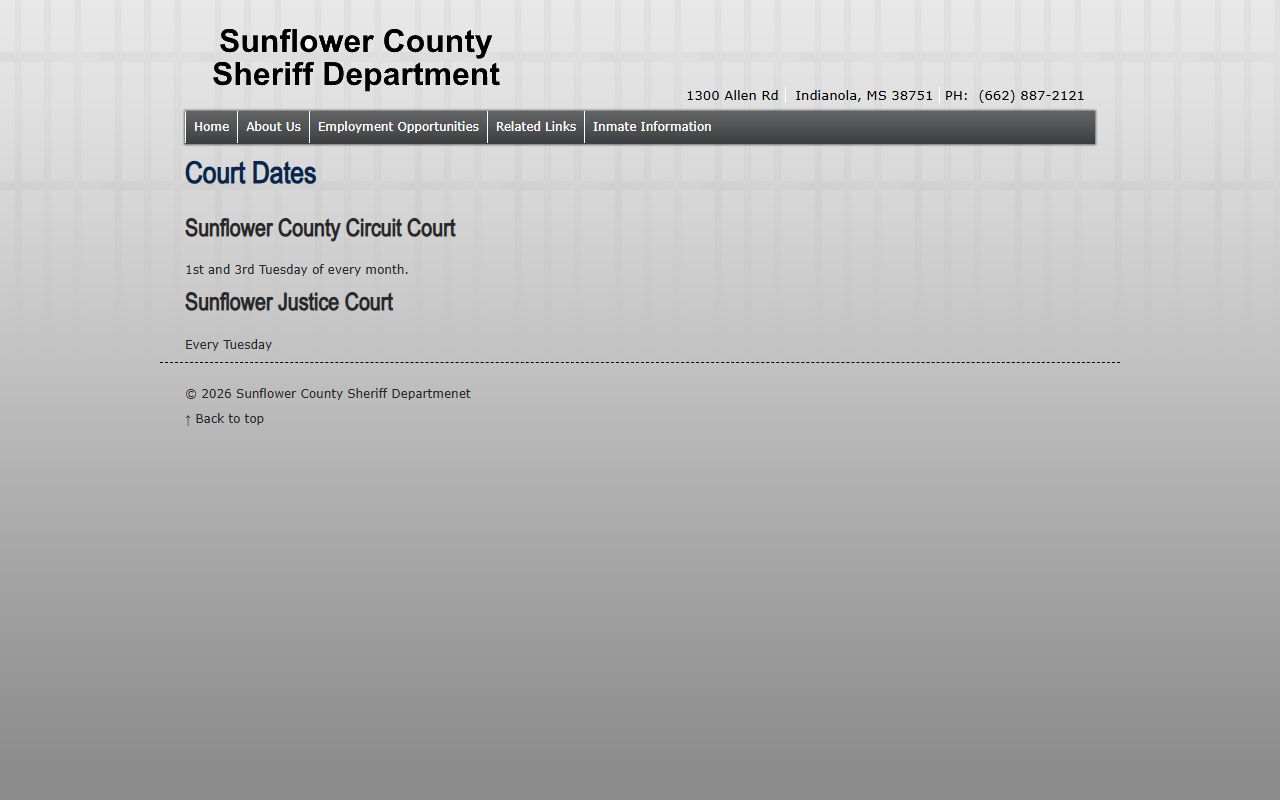
Several Sunflower County courts meet on a predictable weekly or monthly pattern, which helps you anticipate when a docket will be called even before a specific notice arrives. The Sheriff's office publishes the recurring Circuit Court and Justice Court date patterns, and the City of Indianola publishes the Municipal Court schedule. The table below summarizes the standing court dates from those official sources.
| Court | Recurring Date | Typical Matters |
|---|---|---|
| Circuit Court | 1st and 3rd Tuesday of each month | Felony cases and civil suits in the Fourth Circuit District |
| Justice Court | Every Tuesday | Misdemeanors, traffic outside city limits, evictions, small civil claims |
| Indianola Municipal Court | Tuesday (initial appearances 9:00 a.m.; trials 1:00 p.m.) | City ordinance, municipal misdemeanor, and traffic cases inside Indianola |
The Sheriff court-dates page is the source for the Circuit Court and Justice Court patterns, listing Circuit Court for the first and third Tuesday of every month and Sunflower Justice Court every Tuesday. You can confirm the current listing on the Sunflower County Sheriff court-dates page.
Because these are recurring patterns rather than a guarantee for any single case, always treat your individual notice or the judge docket as the controlling date. Indianola Municipal Court holds initial appearances at 9:00 a.m. and trials at 1:00 p.m. on its Tuesday court day. Note: holidays and special settings can shift a court day, so call the clerk before traveling if the date is critical.
How to Read a Docket Entry
Docket entries are written in shorthand that becomes clear once you know the common terms. Each entry pairs a date with an action, and the words below appear repeatedly across Sunflower County criminal and civil dockets. The definitions follow standard Mississippi court usage.
- Cause number
- The court's case-identification number used to track every filing in the matter.
- Indictment
- A grand-jury charging document that begins a felony prosecution in Circuit Court.
- Arraignment
- A hearing where charges are formally addressed and a plea may be entered.
- Motion
- A written request asking the judge to take a specific action.
- Order
- The judge's written ruling or directive on a request or issue.
- Continuance
- A postponement that moves a hearing or trial to a later date.
- Disposition
- The final outcome of a charge or case, such as a plea, verdict, or dismissal.
- Bench warrant
- A warrant issued by a judge, often after a party fails to appear.
Status words at the end of a case tell you where it stands. A matter may read pending while it is active, dismissed if the charge was dropped, convicted or disposed after judgment, or expunged once a court has removed an eligible record from public access. A dismissal with prejudice generally prevents refiling, while a dismissal without prejudice may allow the case to return. Reading these terms together lets you reconstruct a case timeline from the docket alone, even without pulling the full file.
Sunflower County Docket vs. Case File
It helps to keep the two records separate in your mind. The docket is the map; the case file is the territory. A docket entry might read motion to suppress filed, but only the full file contains the motion's text, supporting exhibits, and the judge's eventual order. Many people only need the docket to confirm a date or status, and they never have to request the underlying documents at all.
| Docket | Full Case File | |
|---|---|---|
| Content | Dated list of filings and events | Complete motions, exhibits, orders, judgments |
| Access | Posted judge docket PDFs or DA docket page | Written request to the clerk; fees may apply |
| Best use | Track progress and find court dates | Legal review, evidence, certified copies |
When the docket alone is not enough, the next step is the office that keeps the file. For Circuit Court felony and civil matters, that is the Circuit Clerk, who responds to specific written requests. If you are following a felony prosecution and want the charging documents and outcome, the Sunflower County criminal court records path explains how the full file is assembled and requested.
When to Call the Circuit Clerk
Because Sunflower County has no public online case-search system, a phone call or written request to the clerk is often the fastest way to resolve a docket question. The Circuit Clerk keeps Circuit Court civil and criminal files, judgments, liens, and lower-court appeals, and the office responds to specific requests by email, mail, or in person. A good request names the parties, the cause number if known, the filing or hearing date, the charge or claim type, and whether you need a plain or certified copy.
Contact the clerk before assuming a fee, since costs vary by document type, and a request that lacks detail may draw a per-item research fee. The office honors requests within 14 business days when records are available, and it will notify you if more cost is due. If no record is found, the search fee is not refunded, so a precise description protects your money and time. Reasons to call include a docket entry you cannot interpret, a missing or changed court date, or a need for a certified copy that the posted PDFs cannot provide.
Other courts have their own contacts for docket questions. Justice Court handles misdemeanors, traffic outside city limits, evictions, and civil claims up to 3,500 dollars, and the Mississippi Access to Justice justice court help site explains that jurisdiction in plain terms. For tickets and ordinance cases inside the city, the Indianola Municipal Court page lists the clerk contact and the Tuesday court times.
Limits on Sunflower County Dockets
A docket shows only what the law allows the public to see, and several case types are restricted by Mississippi statute. Youth court records are generally confidential, so juvenile delinquency, abuse, and neglect matters are not searchable like adult criminal cases; access is limited to officials, attorneys, guardians, parties, or those acting under a court order. Adoption proceedings are confidential and heard in closed court, and mental health commitment records are treated as sensitive and restricted.
Sealing and expungement also remove or block entries. When a court grants an expungement under Mississippi law, the eligible record is removed from public access, so it may no longer appear on a docket at all. Sealing restricts public access while preserving the record for the court. Public-facing dockets additionally redact identifiers such as Social Security numbers, financial account numbers, minor names, and certain victim information.
Finally, the posted Sunflower County docket PDFs are scanned files that change as courts update settings, and they are not a substitute for the official case record. Treat them as a planning tool, verify any critical date with the clerk, and remember that a felony case may flow from Sunflower County Circuit Court to the Court of Appeals and the Supreme Court, with each level keeping its own record of events.