
Sunflower County Circuit Court Overview
The Circuit Court sits in the middle of the Mississippi court system. It is a court of general jurisdiction, which means it can hear a broad range of cases. Felony criminal prosecutions belong here. So do civil lawsuits at law, where one party sues another for money or damages. The court also takes appeals from the County, Justice, and Municipal courts, and from administrative boards and commissions. Above the Circuit Court sit the Mississippi Court of Appeals and the Mississippi Supreme Court. Below it sit the limited-jurisdiction courts that handle smaller, local matters.
Sunflower County belongs to the Fourth Circuit District. That district also covers Leflore and Washington counties. The state is divided into 22 Circuit Court districts served by 57 circuit judges, according to the local Circuit Court page. Circuit judges are chosen in non-partisan elections and serve four-year terms. Several judges share the Fourth Circuit District caseload, and one of them keeps a local office in Indianola. The Mississippi Judiciary court structure places the Circuit Court at the trial level for the most serious civil and criminal work.
For Sunflower County, that division shapes where a record lives. Felony files, civil suits, and lower-court appeals stay with the Circuit Court and its clerk. Family, probate, and land matters move to Chancery Court instead.
Fourth Circuit Judges Serving Sunflower County
The Fourth Circuit District is staffed by several elected circuit judges who rotate across Sunflower, Leflore, and Washington counties. Each judge keeps a chambers office in one of the three counties and travels to hold court where cases are set. Judge Carol White-Richard is the judge based locally in Indianola, while the other Fourth Circuit judges sit in Greenville and Greenwood. The Sunflower County Circuit Court page lists each judge along with court administrators, staff attorneys, law clerks, and court reporters who support the docket.
| Judge | Location | Phone |
|---|---|---|
| Judge Carol White-Richard | Indianola (P.O. Box 686) | 662.445.1996 |
| Judge W. Ashley Hines | Greenville (P.O. Box 1315) | 662.334.2787 |
| Judge Margaret Carey-McCray | Greenville (P.O. Box 1775) | 662.334.2797 |
| Judge Richard Smith | Greenwood (P.O. Box 10239) | 662.453.1429 |
Court administrators handle scheduling and docket questions for each chambers. In Indianola, Court Administrator Ashley Nelson and the local court staff share the same Indianola phone line as Judge White-Richard. Callers should ask for the chambers that is assigned to their case, since civil and criminal matters can be assigned to different judges within the district.
Circuit Court vs Justice vs Municipal Court
The Circuit Court is not the only trial court in Sunflower County. Two limited-jurisdiction courts handle the high-volume, lower-level matters that never reach a circuit judge. Justice Court takes misdemeanors, small civil claims, and many traffic cases. Municipal Court handles city offenses inside town limits. The table below shows how the three courts divide the work.
| Circuit Court | Justice Court | Municipal Court | |
|---|---|---|---|
| Criminal jurisdiction | Felonies | Misdemeanors | City misdemeanors and ordinance violations |
| Civil jurisdiction | Civil lawsuits at law | Small civil claims and evictions | Generally none |
| Civil limit | No fixed cap | Up to $3,500 | Not applicable |
| Common case types | Felony crime, civil suits, lower-court appeals | Traffic outside city, evictions, misdemeanors | City traffic, ordinance and code violations |
| Appeals | Receives appeals from lower courts | Appeals go up to Circuit Court | Appeals go up to Circuit Court |
Because the Circuit Court receives appeals from both Justice Court and Municipal Court, a single dispute can move up the ladder. A speeding ticket fought in Indianola Municipal Court, for example, can be appealed into Circuit Court for a fresh hearing.
Note: Justice Court civil claims are capped at $3,500, so larger money disputes are filed in Circuit Court instead.
How a Case Moves Through the System
Cases reach the Circuit Court along two main paths, one criminal and one civil. A criminal case starts with an arrest and ends, if it goes the distance, with sentencing and a possible appeal. A civil case starts with a filed complaint and ends with a judgment that either side may appeal. The two flow lines below trace the usual order of events.
Criminal flow: Arrest › First Appearance › Grand Jury Indictment › Arraignment › Pretrial › Trial › Sentencing › Appeal
Civil flow: Complaint Filed › Answer › Discovery › Motions › Trial › Judgment › Appeal
Most criminal felony cases do not reach a full jury trial. Many resolve through a guilty plea after the grand jury hands up an indictment. Civil cases often settle during discovery or after mediation. At every stage, the Circuit Clerk records the filings, orders, and outcomes that become the public case file.
Felony Cases in Sunflower County Circuit Court
Felony prosecutions are the core of the Circuit Court's criminal work. In Mississippi, only a grand jury may indict a person for a felony. The grand jury hears the case in the county where the crime was committed, then decides whether enough evidence exists to charge. The Office of the District Attorney for the Fourth Circuit Court District presents these felony cases. District Attorney W. Dewayne Richardson leads that office and covers Washington, Sunflower, and Leflore counties.
The path from arrest to trial follows a set order. An arrest is made by warrant or on probable cause. The accused receives a first appearance, where bond and rights are addressed, and qualifying low-income defendants may be assigned court-appointed counsel. The case is then presented to a grand jury. If the grand jury returns an indictment, the defendant is arraigned and the case is set for pretrial work, a plea, or trial in Circuit Court. The district attorney's judicial-process page walks through each of these steps.
Felony case files held by the Circuit Clerk can include the indictment, arraignment entries, bond orders, plea petitions, trial settings, jury verdicts, and sentencing orders. County-level and city-level prosecutions are handled separately. County Prosecuting Attorney Gwendolyn Jimison handles lower-court county matters, which are distinct from the district attorney's felony role.
Note: A felony charge in Sunflower County must be returned by a grand jury indictment before the Circuit Court can hold a trial on it.
Civil Lawsuits and Appeals in Sunflower County
The Circuit Court hears civil lawsuits at law, the cases where one party seeks money damages or other legal relief. The Circuit Clerk receives and files the complaints, answers, motions, and other papers in every civil case opened in the court. The same office issues summonses and subpoenas, pulls and qualifies jurors, and keeps the record of judgments and liens that civil cases produce. A money judgment entered here can lead to post-judgment collection steps such as garnishment.
The Circuit Court also serves as the appellate court for the local limited-jurisdiction courts. Appeals from Justice Court, Municipal Court, and administrative boards and commissions are filed with the Circuit Clerk and decided by a circuit judge. That appellate role is one reason the court touches so many local disputes, even those that began over a small fine or a city ordinance. A civil case file follows the same flow shown above, from complaint through judgment and any appeal.
Sunflower County Circuit Court Dates
Circuit Court in Sunflower County follows a recurring schedule. According to the Sheriff's court-dates page, Circuit Court meets on the first and third Tuesday of every month, while Justice Court meets every Tuesday. Knowing these standing dates helps defendants, witnesses, and family members plan a courthouse visit. Specific hearings and trials are still assigned by judge docket, so the standing dates are a starting point rather than a guarantee.
Judge dockets are published in two main places. The Circuit Clerk posts docket links by judge, and the district attorney maintains a Sunflower County docket page that advises defendants to review the judge docket and to contact the Victim Witness Coordinator with questions. Anyone tracking a setting can also review the Sunflower County court dockets for hearing and trial listings before traveling to court.
Accessing Sunflower County Circuit Court Records
Circuit Court case files are kept by the Sunflower County Circuit Clerk, Carolyn Hamilton, at 200 Main Street in Indianola. There is no online case search and no online payment for record copies. Every record search must be presented in writing, by email, by mail, or in person, and it should describe the documents sought in specific detail. The Circuit Clerk services page sets out this written-request policy in plain terms.
The Circuit Clerk does not offer a web-based record search. Requests are filled within 14 business days if the record is available, fees vary by document type, a research fee per item may apply when a request lacks detail, and there is no refund of the search fee if no record is found.
For the cleanest result, a requester should include a party name or case number, the type of document, and an approximate date range. The office mails or releases copies once any fee is paid. A full breakdown of fees, mailing addresses, and request steps is set out on the Sunflower County Circuit Clerk page. Marriage licenses and certified marriage copies are also issued by this same office.
Sunflower County Lower Courts and Chancery
Several courts work below and beside the Circuit Court. Justice Court handles misdemeanors, traffic violations outside city limits, evictions, and small civil claims up to $3,500. Sunflower County Justice Court judges include Lisa Bell, based in Ruleville, and Gwendolyn Pernell, based in Indianola, and the court meets every Tuesday. The Mississippi justice-court help site explains jurisdiction, timelines, and self-help options for these matters.
Municipal courts handle city ordinance violations, city misdemeanors, and traffic citations issued inside a town. The Indianola Municipal Court at 101 Front Street is the busiest of these in the county. Cases decided in Justice Court or Municipal Court can be appealed up into Circuit Court, where a circuit judge reviews them anew.
Equity, divorce, custody, adoption, probate estates, guardianships, conservatorships, and land records do not go to the Circuit Court at all. Those matters belong to Chancery Court. Sunflower County sits in the Ninth Chancery Court Subdistrict Two, where Chancellor Debra Giles presides, with the court office at 200 Main Street in Indianola. Knowing the Circuit and Chancery split keeps a records request pointed at the right clerk.
Federal Court Records for Sunflower County
Not every case from Sunflower County is heard in state court. Federal crimes and federal civil suits are handled by the U.S. District Court for the Northern District of Mississippi, which keeps courthouses in Aberdeen, Greenville, and Oxford. These files are not kept by the Sunflower County Circuit Clerk or Chancery Clerk. The Northern District of Mississippi district court is the federal trial venue for the area.
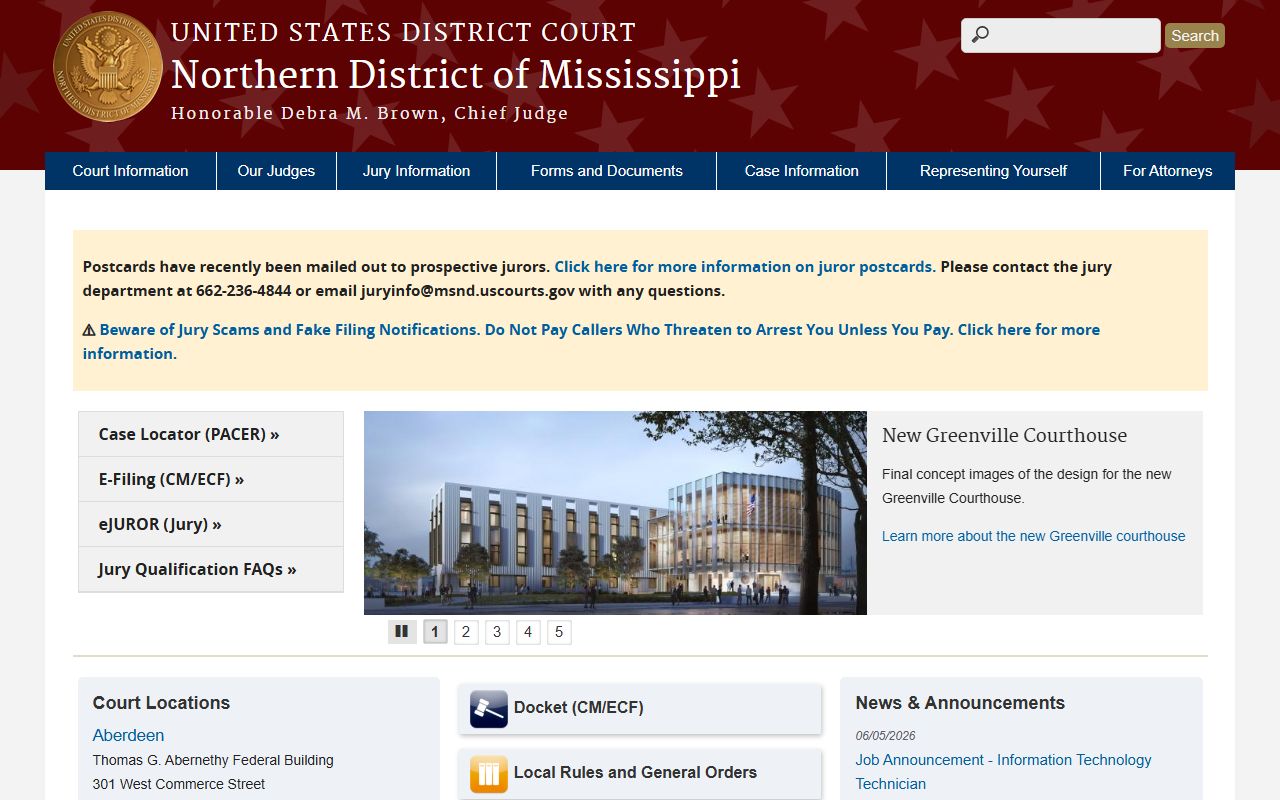
The district court's own website is the entry point for hours, contact details, and case procedures. To look up a specific federal case, the public uses the court's case-information resources.
The Northern District case-information page explains how dockets and case files are organized and where to search them.
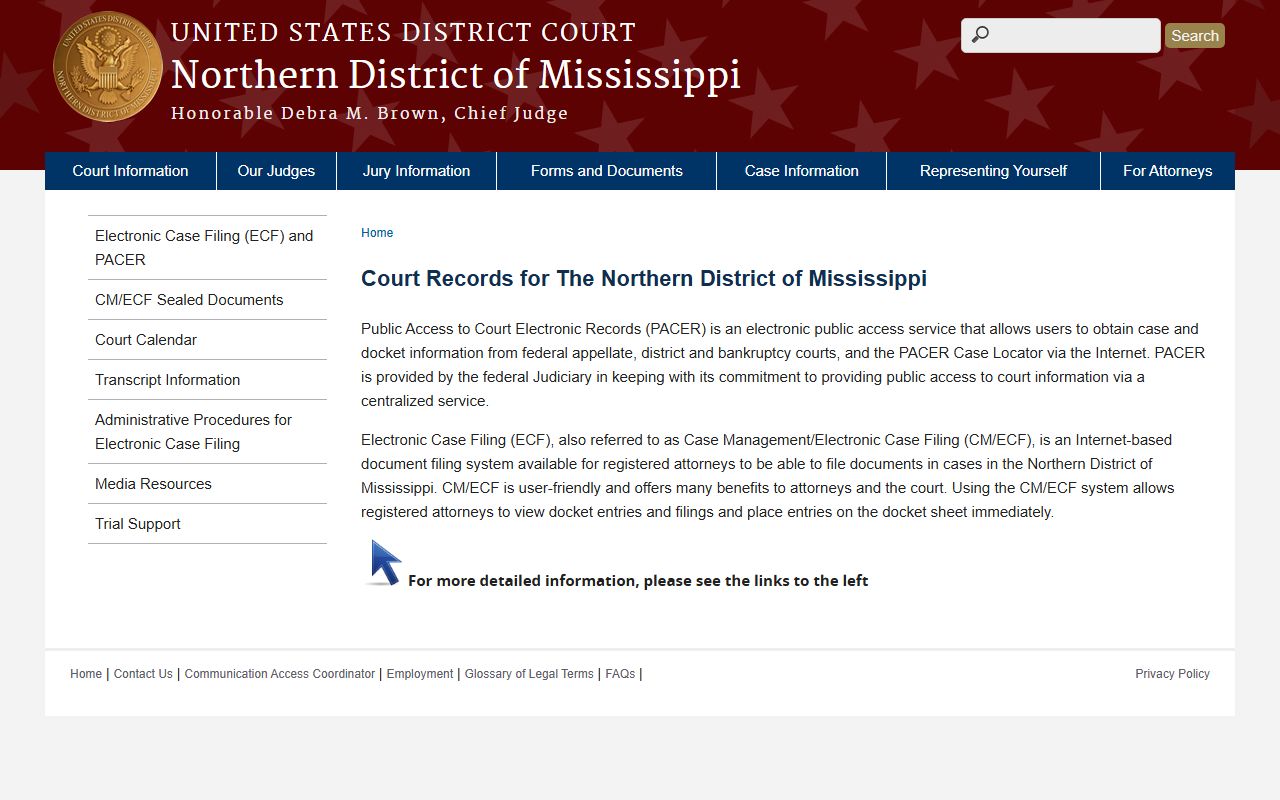
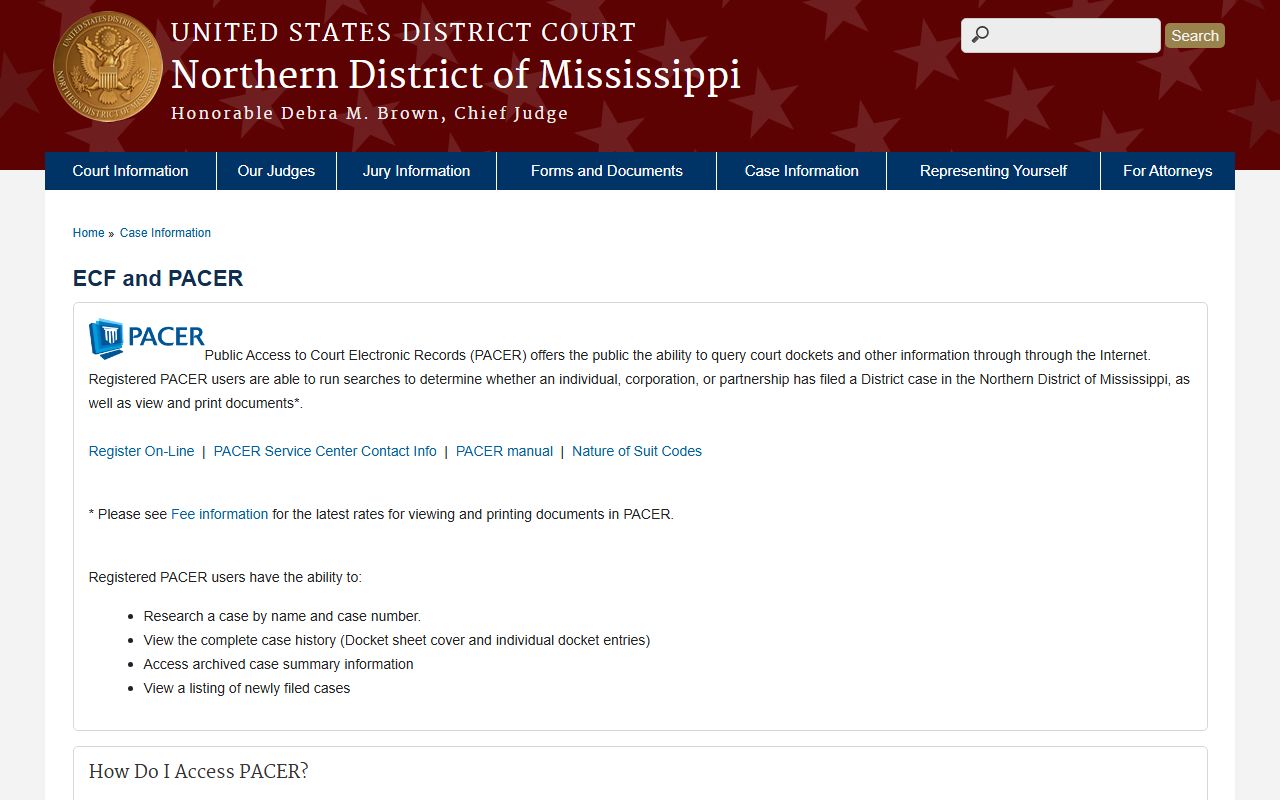
Most federal docket searching happens through PACER and the court's electronic filing system, CM/ECF. The Northern District ECF and PACER page describes how registered users query federal dockets and view documents.
Attorneys and registered filers reach the system through the court's login portal. The Northern District CM/ECF login is where electronic filing and document retrieval begin for registered accounts.
Members of the public who only need to find a case can use the national lookup tool first. The PACER lookup for the Mississippi Northern District points to the right court before a search begins; PACER requires registration and may charge document fees.
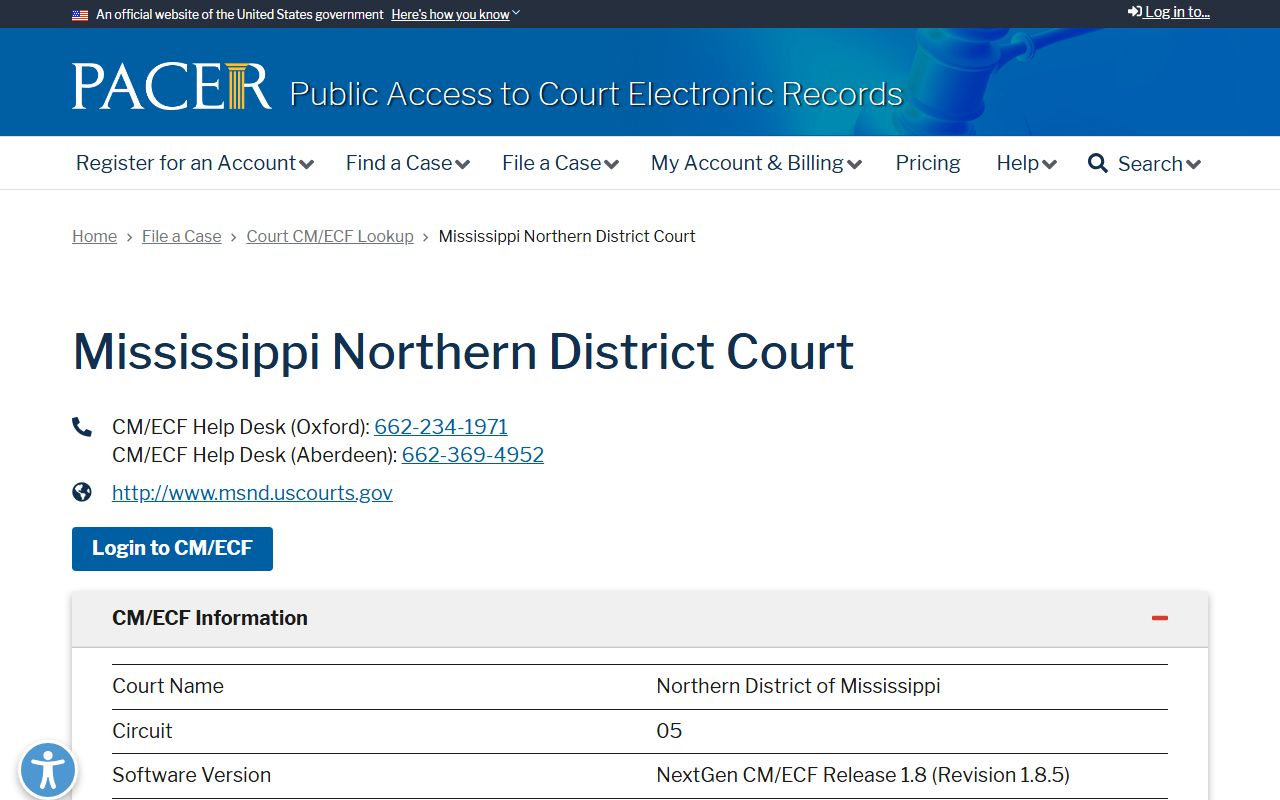
Federal appeals from this district go to the U.S. Court of Appeals for the Fifth Circuit. The Fifth Circuit Court of Appeals reviews federal trial-court decisions for Mississippi, Louisiana, and Texas.
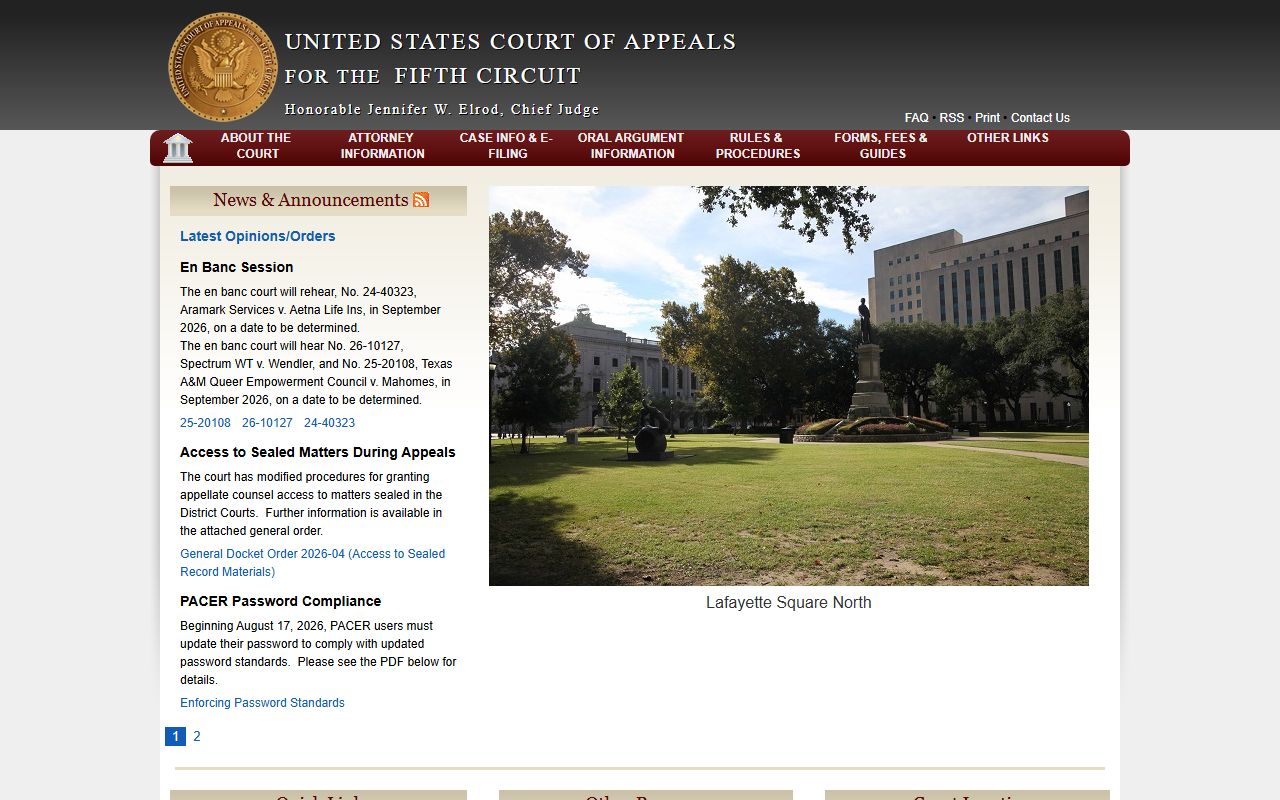
The Fifth Circuit handles the appellate stage for federal cases, much as the Mississippi Court of Appeals and Supreme Court do for state matters. For most Sunflower County residents, though, the Circuit Court remains the trial court that matters most.